




























‘Motivation was not as high for World Cup’: Craig Fulton on India’s contrasting priorities in mixed 2026
The Indian men’s hockey team had a mixed 2026. It started with a lowly eighth-place finish in the FIH Pro League before another eighth-place finish in the World Cup. But after a short turnaround, India retained its continental titles — the Asian Games in Japan and the Asian Champions Trophy (ACT) at home. The Asiad success also ensured India successfully booked its Olympics berth in Los Angeles in 2028.
For head coach Craig Fulton, who had to steer through a rocky start to the year before finishing on a high with two titles, the task is only getting started. Back in Bengaluru, Fulton is already busy getting a group of inexperienced internationals and junior players for the test series in New Zealand starting next week.
After his first training session, Fulton spoke to Sportstar on the key takeaways from the year, differing motivation in a packed calendar, the road to the LA Olympics, managing transition, players adjusting to the new kit colour and more.
After the World Cup, what are your takeaways from the successive Asian Games and Asian Champions Trophy campaigns?
I think it was really nice to get back on track after the World Cup. The World Cup was difficult and [it was about] fine margins, like really fine margins in certain phases of games. Even the top teams that didn’t make the semifinal, and for those teams that did make the semis, there were fine margins that changed results in big games.
And it was the same in the Asian Games. If you look at the semifinal against Pakistan, all the momentum was with us. We were obviously dominating the pool and then we knew at some point we were going to play Pakistan. But when you play Pakistan in a Pro League, it’s not really for anything besides pride. But now you’re playing them for a place in the final of the Asian Games and the ability to earn an Olympic spot, everything changes. So I’m glad that we did a good job in the second half and found a way to win. Then the difference in the final was clear because obviously it’s always difficult playing India-Pakistan matches for games of consequence like the semifinal. I’m glad that we had the right players on the field at the right time and were able to execute.
This has been a testing year for the Indian team and yourself in terms of performances and results. From a management and technical point of view, how do you assess this year?
Well, the takeaway is Asian Games gets totally different support.
So, from all the states that have Asian Games athletes, financially they are highly motivated to do well in the Asian Games because it’s linked to the Olympics. So that’s really, really positive for our Asian Games campaign. So players know financially if we win a gold medal and qualify, they get ‘X’ already. So now they step into that reward system. And if you trace back how well athletes have done in the Asian Games going towards an Olympic qualifier, because they get rewarded, the focus is much higher. It’s really important that that happens.
Then we come back and then the players get rewarded for it. Then a week or so later, we’ve got to go and play ACT in Punjab. That’s also a big thing because it’s about players who haven’t played at home for 15 years.
They haven’t had international hockey in Punjab, so there’s another real big incentive to do that in front of their friends, families, states, academies.
So the takeaways are that Asian Games and the Olympics are well rewarded. It’s well documented that players that have done well in the Junior Olympics, the Asian Games, and go on to the Olympics, they get rewarded heavily from the states for that. So it’s a very proud connection for states to Asian Games, to Olympics, and they get rewarded.

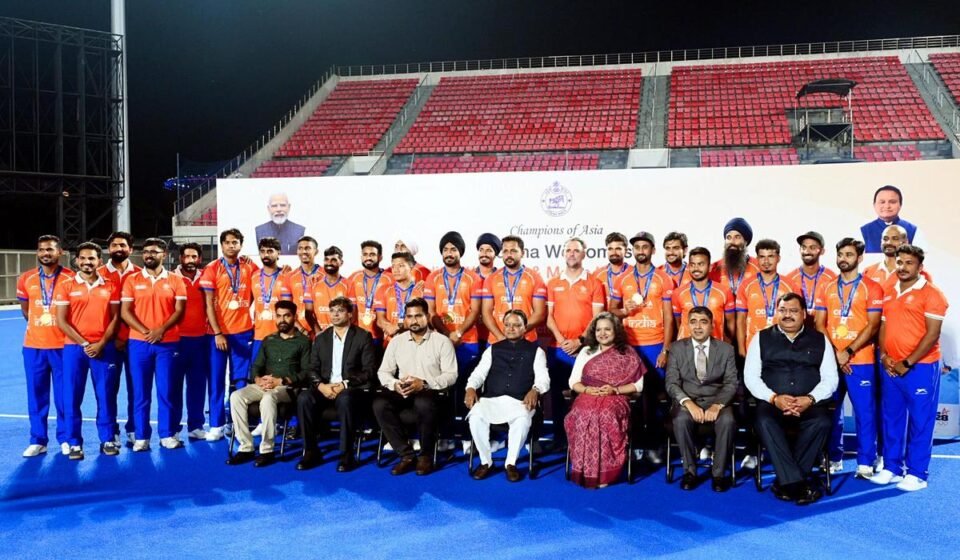
India men’s hockey team was felicitated in Bhuvaneswar for winning gold medal at the Asian Games 2026 by Odisha Chief Minister Mohan Charan Majhi.
| Photo Credit:
ANI

India men’s hockey team was felicitated in Bhuvaneswar for winning gold medal at the Asian Games 2026 by Odisha Chief Minister Mohan Charan Majhi.
| Photo Credit:
ANI
So the motivation is there: highly motivated athletes to do well. The World Cup situation was slightly different. If you look back at why there’s not such a history of performance in the World Cups, and then if you have the World Cup and three weeks later, you have the Asian Games, we have a clash of priorities.
That’s the takeaway for me as a coach, as I’m aware of how the system works. So if you get injured in the World Cup and you don’t play Asian Games, you lose out. So I don’t think the motivation was as high for the World Cup.
I’m not trying to say that there’s any one player. I just think psychologically, in the big picture, Asian Games and Olympics, they’re on two different levels.
Speaking about the clash with the fixtures, at the start of the year, during the Hockey India League, you had mentioned that you wanted to build two strong squads going into the World Cup and the Asian Games. But when it came to both the tournaments, there weren’t many big changes.
It wasn’t possible because the teams had to be named 60 days before the Asian Games. So in the future, if I looked at the squad and the performances from the World Cup, and then selected them for the Asian Games, that would have been ideal. But it’s not possible because the timing is so close for visas, for all the accreditations and for clothing.
It’s just how it is. That’s why it’s not ideal to have two major tournaments back-to-back.
With the Olympics tickets secured, you have the New Zealand Tour next and the Pro League next year. In terms of the squad, building up to the LA Olympics, what will you be looking at to get the squad ready for the Summer Games?
We take the India A group to New Zealand. Then hopefully, if there is the Hockey India League that gets played in January, we choose a new squad for Pro League in February.
So we just have to wait and see. Because we’ve had two major tournaments this year — Asian Games, World Cup — and we look at almost two years away from LA and ask, what do we need? Where are we at? And how do we try and get the next group of players ready so that we have almost three players per position? So that we can create competition and depth. So if we lose one player, we still have two and we build a squad depth like that.
There’s a lot of chatter around the Indian team in terms of the senior players. Even before the Champions Trophy, there were reports over a certain number of players playing their last games for India. The Chief Selector, RP Singh, after the tournament, said that some of the senior players probably need to come forward and decide their futures with respect to their place in the lead up to the LA Olympics. Was there a conversation you have had with the senior players about the road ahead?
No. Basically, I had a conversation with Nilakanta [Sharma] during the Asian Games. He really just wanted to play his last tournament in India and I made that happen with the selection, which was the right call for him. He felt he had reached where he wanted to go with his career and it was time for him to step away.
I need to ask you about the other three names which were also mentioned in the reports. Jarmanpreet Singh, Mandeep Singh and Amit Rohidas.
There’s nothing official there. We just have to see what happens with the Hockey India League. Then look after the India A Tour that we go on.
It’s a little bit similar to the Azlan Shah Tour that we went on. We took a lot of this group there, so we have good information. Then we’ll put together the squad of what we need, what we think we need going forward to LA.
You spoke about creating a real depth. Are you happy with the number of matches the A Group and the junior team gets to play? Do you feel like there is enough depth for you to look at? Enough data, enough video footage for you to assess when you look at the next pool of players coming through?
Everything is on video. We film everything. So, with the Under-21s, their whole grouping is of 40 players. Our grouping is of 40 players, that’s the senior squad, 33 plus the extra players who come from the India A. So, all the senior, India A and U-21 sessions are filmed. We see it all the time in whatever games they play. It’s all coded.

India defeated Japan to clinch the recently held Asian Champions Trophy.
| Photo Credit:
RV MOORTHY
India defeated Japan to clinch the recently held Asian Champions Trophy.
| Photo Credit:
RV MOORTHY
Yes, I see enough for sure. To put them in front of international teams, that’s the goal for 2027. To get more games in 2027, because there’s only the Pro League and maybe the Asia Cup. But there are no major tournaments in 2027, so we want to get games in that year.
With this group of players for the New Zealand tour, what are the key attributes do you look as a collective and from an individual standpoint for you to think that these players are ready for the senior international circuit?
I think if you just take from goalkeepers, set-pieces, PCA [Penalty Corner Attack], PCD [PC Defence], how efficient we are pushing, trapping, flicking under enough pressure, so-called international pressure, and the ability to execute our same tactics, our high press, our half-court press, our low press.
Then the ability to counter-attack, win the ball and counter-attack. Those are the areas that we focus on as basics. If players are able to do it in training constantly and show that they have good game intelligence and good decision-making, then that helps them progress fast to the next level, which would then be to come train with us and then see against our internationals to see how they fair.
Then if that’s consistent, then you come away with us to a tour or a tournament or like the New Zealand tour.
Do you feel there needs to be a refresh with the squad heading to the Olympics?
At any time, a team comes to its ceiling. At the same time, it’s also about refreshing it.
Sometimes, big teams [European teams, Argentina and Australia], their key players don’t play for six months. Because they just focus on league hockey, they get themselves refreshed mentally and they physically go away and work on their strength and conditioning for six months. Then they come back and then they feel refreshed.
They feel like they have another level to get to. It’s the same player, but you almost think, ‘Wow, what’s happened to this guy? He looks new again.’ So there’s that side of it.
Then there’s the other side of it where there are younger players who are pushing and need an opportunity. Then they deserve that opportunity because they are already overtaking that senior player on our training drills, on the areas that I’ve just discussed. And that means, okay, he’s in a good place to take over.
Do you feel like there are players who are ready to take that step where they are ready to push the senior players?
Yeah, that’s why we have the India A and we train and play against each other because iron sharpens iron — that’s what we need.
We need to have competition for places. If someone is complacent and doesn’t have competition, then they think their level is fine. But if someone is put in that same situation and is overtaking them for whatever reason, technically, tactically, mentally and physically, then that definitely is you creating the right environment to improve the team.
This year, India has had consistent success against the Asian teams. You have won all the 14 matches you have played against them. But the results haven’t been great against the European sides and the rest of the world. What is it that you will be looking at in terms of trying to bridge that gap heading to the Olympics?
Well, the beautiful thing is, I love the fact that it’s the Olympics. And everyone, like I said to you in the beginning, the Olympics is on a higher level of incentive.
So we’ll have everyone 100% in the right mental state to push. That’s the first thing. Why are we doing this? We want to try and repeat the podium and change the colour of the medal and try and win gold in LA.

According to Craig Fulton, the jersey colour switch from blue to orange has made an important difference.
| Photo Credit:
AP
According to Craig Fulton, the jersey colour switch from blue to orange has made an important difference.
| Photo Credit:
AP
That’s the number one goal. But at the same time, we are ranked 8th in the world. So there’s a gap between us and the rest.
But looking at the World Cup, the teams that were ranked 5th and 6th in the world made the semifinal and the teams that were 1st and 3rd didn’t make the semifinal. So our sport and men’s hockey is thriving at the moment and the competition is very, very good.
Do you feel fitness-wise, this team will be able to match up going into this next year?
100% we will. Yeah. The bottom line is, it’s just about working back from LA to now. It’s 18 months. What does the programme look like? What is 2027 as a macro cycle? What is the detail in 2027? Then what does 2028 look like? How do we peak at the right time with this amount of time? We’re fortunate that we are like Belgium and the USA.
We’ve already qualified, so we can plan. Now it’s about putting our plans in place to make sure that the big blocks are done well. What does the S&C look like around that? And what does our competition phase look like around that? And like we did for Paris, create a lot of games, a lot of top games against other teams outside of Asia, to put it like that.
We need to play the best, the top 5 teams, top 6 teams, as much as we possibly can.
Finally, one of the topics which was largely discussed during this year was the jersey colour change before the World Cup. You have had nearly 18 games in this kit. From a technical point of view, how do you think it has made a difference in how the team has played its hockey?
I’m not here to say it’s right or wrong, what colour the jersey should be or shouldn’t be. But the more that you play on a blue pitch, the more contrast you can create makes a difference. So from that technical point of view, I think it’s made a really important difference.
So when we play Japan in the final, and they play in dark blue on a dark blue pitch at night, it’s not easy. Now we’re playing in orange, still playing for India, but in orange on a blue pitch at night, we see each other like clear as day. And that makes a big difference.
Also, the orange socks on the blue pitch, if you have blue socks on a blue pitch, and if you have black shoes, you know it clashes like this over time. So, I’m happy with where we’re at with the colours.
Did it prove to be a distraction at any point?
No. We are here to play hockey.
Published on Nov 10, 2026