

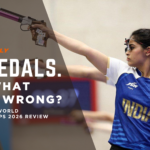














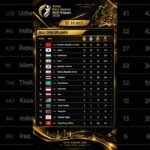





















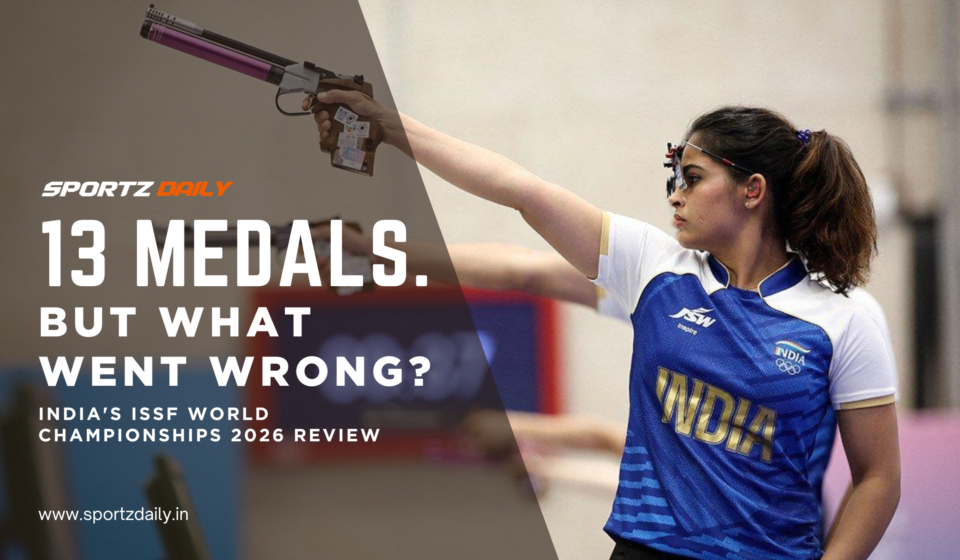
India finished third in the medal standings at the 2026 ISSF World Championships in Doha with an impressive 13 medals. However, beneath the overall medal count lies a bigger concern: Indian shooters are finding it difficult to turn strong qualifying performances into podium finishes, particularly in Olympic events.
On paper, India’s campaign at the 2026 ISSF World Championships looks impressive. A total of 13 medals, including two gold, seven silver and four bronze, secured India third place in the overall standings.
But the bigger picture tells a different story.
With the championship also serving as an important qualification event for the Los Angeles 2028 Olympics, India’s performance has raised questions about its preparedness for the biggest international shooting competitions.
Only three of India’s 13 medals came in Olympic shooting disciplines. Jaypal Malviya, Niraj Kumar and Vivaan Kapoor were India’s medal winners in Olympic events, with each also securing an Olympic quota place.
For a country that has consistently produced world-class shooters and enjoyed success on the international circuit, the results in Doha have highlighted some areas that need urgent attention.
So, what exactly went wrong for India?
1. Winning Medals Is Not the Same as Winning Olympic Medals
The biggest concern from India’s Doha campaign was the difference between its overall medal tally and its performance in Olympic disciplines.
Of the 13 medals India collected, only three came in events included in the Olympic programme.
This represents a significant decline compared to the 2025 World Championships, when Indian shooters secured eight medals in Olympic events across the rifle, pistol and shotgun competitions.
India’s performance in 2022 and 2023 had also produced just two and three Olympic-event medals respectively. This suggests that the exceptional 2025 campaign may have raised expectations beyond India’s current consistency at the highest level.
The challenge now is not simply to win more medals, but to consistently compete for podium finishes in events that matter at the Olympics.
2. Reaching Finals but Failing to Convert Opportunities
One of the most noticeable issues in Doha was India’s finals-to-medals conversion rate.
Around 10 Indian shooters qualified for individual finals, including Paris Olympics medallist Manu Bhaker, who reached the finals in both the 10m and 25m air pistol events.
However, only three of those individual final appearances resulted in medals in Olympic disciplines.
This is an area where India needs to improve.
Reaching a final requires consistency, precision and excellent preparation. But winning a medal demands something more: the ability to handle pressure, maintain concentration and deliver when the competition becomes intense.
Indian shooters have shown that they can compete with the world’s best during qualification rounds. The next step is developing the confidence and composure needed to finish among the top three.
3. Pistol Shooting Remains a Major Concern
India’s pistol contingent entered the championship with considerable expectations, but the results were once again below expectations.
The women’s 10m air pistol event was particularly disappointing.
Despite having talented shooters such as Manu Bhaker and Suruchi Phogat, India failed to secure a medal in the event.
Manu reached the final but finished fifth, while Suruchi finished sixth. This came after India’s disappointing results in the women’s air pistol events at the Asian Games.
The men’s pistol category offered a brighter moment through Jaypal Malviya, who secured silver in the 10m air pistol event despite competing in only his second international tournament.
His performance was one of the positives from India’s campaign.
However, India’s pistol programme needs greater consistency, especially with major Olympic qualification competitions approaching.
4. Fatigue and a Demanding International Schedule
Another possible factor behind India’s performance was the demanding competition calendar.
The World Championships followed a hectic season involving national selection trials, World Cup competitions and the Asian Games.
For athletes competing at the highest level, physical preparation is only one part of the challenge. Mental recovery is equally important.
Shooting requires extraordinary concentration, technical precision and emotional control. Competing in multiple high-pressure tournaments within a short period can affect an athlete’s ability to perform consistently.
Dronacharya Award-winning rifle coach Neha Chavan suggested that the timing of the championship may have influenced the results, indicating that a few additional weeks of recovery could potentially have helped the shooters.
A better competition calendar and carefully planned recovery periods could therefore become important factors in India’s preparation for future international events.
5. Team Selection and Consistency Need Attention
Another issue highlighted by the campaign is the frequent changes in team combinations.
India’s national selection system involves intense competition, with athletes required to maintain strong performances in trials to secure their places in international teams.
While competition for national selection can improve standards, frequent changes in team combinations may also affect preparation and continuity.
The men’s 10m air pistol team provides an example, with only one shooter featuring in the three-member combinations selected for the Asian Games and World Championships.
Building stronger combinations, giving athletes adequate international exposure and maintaining continuity where appropriate could help improve team performance.
The goal should be to create a system in which athletes can prepare for major competitions with clarity, confidence and consistency.
6. Can India Still Secure More Shooting Quotas for LA 2028?
Despite the disappointing aspects of the Doha campaign, India’s Olympic shooting ambitions are far from over.
India secured three Olympic quota places at the 2026 ISSF World Championships. However, several qualification opportunities remain before the Los Angeles 2028 Olympics.
The upcoming international calendar includes:
- 2027 World Rifle and Pistol Championships.
- World Shotgun Championships.
- Multiple Asian Championships.
- Additional ISSF Olympic qualification competitions.
India secured 21 shooting quota places for the Paris 2024 Olympics. Matching or improving that number for Los Angeles will be an important target.
However, securing more quotas will require consistent performances across all three disciplines: rifle, pistol and shotgun.
India has the talent and infrastructure to remain among the leading shooting nations. What matters now is translating that potential into results when Olympic qualification opportunities arrive.
What Needs to Change Before Los Angeles 2028?
India’s campaign in Doha should be viewed as a learning opportunity rather than simply a disappointing result.
There are several areas that deserve attention:
Better finals preparation: Shooters must develop the ability to handle pressure and convert final appearances into podium finishes.
Improved recovery management: Competition schedules should allow athletes sufficient physical and mental recovery.
Greater team stability: Consistent team combinations and better preparation could help improve coordination and confidence.
Stronger pistol performance: India’s pistol contingent needs to rediscover the consistency it has demonstrated at previous international competitions.
More international exposure: Young shooters should receive opportunities to compete against the world’s best in high-pressure environments.
The Bigger Picture: India Has Talent, But Consistency Is Key
India’s 13-medal finish in Doha is certainly an achievement, but the limited success in Olympic disciplines provides an important reminder that overall medal standings do not always tell the complete story.
The country has talented athletes, experienced coaches and a growing shooting ecosystem. The challenge is bringing all these elements together at the right time.
With Los Angeles 2028 approaching, Indian shooting cannot afford to rely only on individual brilliance. It needs a consistent system that delivers results across rifle, pistol and shotgun events.
The message from Doha is clear: India knows how to reach the finals. Now, it must learn to finish on the podium more consistently.