ISSF Shooting World Championships: Does India’s 13-medal haul masks other problems
India’s two gold, seven silver and four bronze medals placed it third behind China and Italy at the recently concluded ISSF World Championship in Doha, Qatar. Three Olympic quota places, secured by Jaypal Malviya in 10m air pistol, Niraj Kumar in 50m rifle 3 positions and Vivaan Kapoor in Trap, marked tangible progress towards Los Angeles 2028.
Yet the tally concealed a more complicated picture. While relatively unfamiliar names delivered, several established shooters faltered. Weaknesses in air rifle disciplines were laid bare and questions about coaching and the junior development pipeline were raised.
Rifle’s worrying regression
Five of India’s six participants in the men’s and women’s 10m air rifle competitions failed to reach the finals. Elavenil Valarivan, the lone Indian finalist, finished sixth.
In the men’s competition, Parth Mane, Himanshu Dhillion and Parth Makhija placed 16th, 41st and 61st, respectively. Mane, who had operated around the 633-point mark in qualification rounds of ISSF events earlier this year, managed 630.3, while Dhillion scored 628.1 and Makhija 625.2. In contrast, China’s Sheng Lihao shot 637.2, underlining the scoring ceiling that India’s rifle shooters need to aspire to.
Sonam Maskar and Shambhavi Kshirsagar also fell short in the women’s event, finishing 19th with 630.5 and 32nd with 629.7, respectively. Shambhavi’s campaign suffered another setback when she was disqualified from the mixed-team competition over the stiffness of her suit, following a similar equipment-related disqualification in the individual event at the Junior World Championship in June.
There is little doubt that India has fallen behind the eight ball considerably in the air rifle discipline. Its shooters can produce high scores, but converting that potential into results at major international competitions remains a challenge.

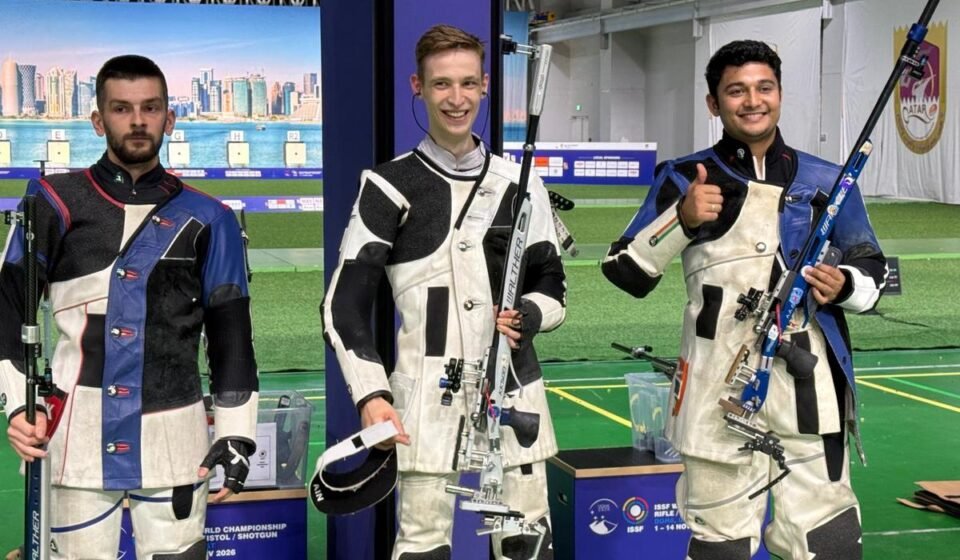
Niraj Kumar won the men’s 50m rifle 3 positions bronze medal and secured an LA 2028 Olympics quota place for India.
| Photo Credit:
Special arrangement

Niraj Kumar won the men’s 50m rifle 3 positions bronze medal and secured an LA 2028 Olympics quota place for India.
| Photo Credit:
Special arrangement
Coaches fall out even as the system struggles
As first reported by Sportstar, a mid-tournament altercation between foreign rifle coach Thomas Farnik and his national counterpart Deepali Deshpande added to the concerns. The disagreement, which escalated during a team debriefing, saw both coaches blaming each other for the debacle.
A first-person account cast a spotlight on fractured relationships within the National Rifle Association of India’s (NRAI) backroom at the very start of the qualification cycle for LA28. “It felt a little wrong, whatever was happening, so we left,” a participant in the meeting said under conditions of anonymity.
The federation must, while taking cognisance of the problem at hand, clearly define the roles and responsibilities of each coach. “We have heard of the incident. Once the World Championship gets over, we will be taking up the matter. There will be appropriate measures going ahead,” NRAI president Kalikesh Narayan Singh Deo said.
Shambhavi’s disqualification also highlights the need for preventive checks ahead of competitions. At this level, avoidable errors can prove to be as costly as poor shooting.

Jaypal Malviya won the silver medal in the men’s 10m air pistol event at the ISSF World Championship 2026 in Doha, Qatar, to secure India’s first LA 2028 Olympics quota in shooting.
| Photo Credit:
Special arrangement
Jaypal Malviya won the silver medal in the men’s 10m air pistol event at the ISSF World Championship 2026 in Doha, Qatar, to secure India’s first LA 2028 Olympics quota in shooting.
| Photo Credit:
Special arrangement
The junior pipeline India cannot afford to lose
Doha also revives the debate over the discontinuation of the NRAI’s junior development programme in order to accommodate the centrally funded Khelo India Games from 2016-17.
In August 2024, former NRAI president Raninder Singh and late pistol coach Jaspal Rana called for the reins of the programme to be handed back to the federation. Jaspal had argued that producing an Olympic-level shooter requires years of development, rather than simply identifying athletes who are already performing well.
The programme, which helped develop shooters like Manu Bhaker and Divyansh Singh Panwar, connected junior talent with experienced coaches. Government support did not disappear overnight, but whether the replacement has replicated the same sport-specific continuity and technical mentoring remains an open question.
Kalikesh spoke in favour of reintroducing the junior programme. “We have discussed it with the government already, and it is also supportive of the idea. They have asked us to work with the National Centre of Excellence (NCOE) athletes. Some junior athletes are there. We can work together to make sure the correct people are included. There is a plan in place for implementation, but there are a few local hiccups. The NCOE coaches and its current staff need coordination. There is some element of resistance there,” he told this publication.

Manu Bhaker finished fourth in the 25m sports pistol and fifth in the 10m air pistol. However, she made up for it by winning the 25m pistol team gold medal with Esha Singh (left) and TS Divya (centre).
| Photo Credit:
Special arrangement
Manu Bhaker finished fourth in the 25m sports pistol and fifth in the 10m air pistol. However, she made up for it by winning the 25m pistol team gold medal with Esha Singh (left) and TS Divya (centre).
| Photo Credit:
Special arrangement
Medals flatter the picture
Not every podium carries the same significance for Olympic preparation.
In Doha, more than half of the total medal count — seven of 13 — came in team events that will not feature at Los Angeles 2028. Three other medals came in individual non-Olympic events.
These achievements deserve recognition, but they cannot be considered a meaningful measure of progress on the ‘Road to LA’. The distinction matters particularly in rifle, where team medals can mask individual shortcomings.
Quotas bagged can be a yardstick for judgement, but differences in allocations across Olympic cycles can complicate comparisons. The 2022 Worlds in Cairo (only for rifle and pistol) offered 32 quota places across eight individual events, with four available per event. Doha offered three per event across 12 disciplines, including shotgun.
In 2026, Manu finished fourth in the 25m sports pistol and fifth in the 10m air pistol. Under the previous allocation rules, her performance in either event would have put India in a position to secure another quota (there were two Chinese shooters in the top four of the 10m air pistol final, making only one eligible for an Olympic quota).
Similarly, neither Swapnil Kusale nor Bhowneesh Mendiratta would have won quotas in 2022 if the current rules had been applicable, with both having placed fourth in 50m rifle 3 positions and Trap, respectively. India had secured two quotas at the 2022 rifle/pistol World Championship, with an additional one in trap secured at the separate shotgun Worlds. The raw totals, therefore, do not tell the whole story.
There is another measure that offers some encouragement. The number of Indian rifle and pistol finalists at the first World Championships of the last four Olympic cycles has increased from three in 2014 (in the lead-up to Rio 2016) to four in 2018 (Tokyo 2020), six in 2022 (Paris 2024) and eight in Doha (LA 2028). The growing number suggests a broader competitive base, even if medals and quotas remain unevenly distributed.
The real verdict
The absence of prominent names also shaped the campaign. Arjun Babuta and Rudrankksh Patil were overlooked in favour of younger shooters following domestic trials. Their omission, however, was not necessarily evidence of decline.
Whether the trials need to reward experience a bit more was a question left for Kalikesh to answer. He said, “We are trying to leave very little discretion to the selection committee. So, most things are in black and white. And it was the new names who made us proud this time. We are also giving some bonus points for international performances. So, we are trying to better balance the shooter’s achievements with current form. Ultimately you can be a great shooter, but if you are not in form, you will never perform. No matter what the policy is, the best shooter in the best form normally comes through. Yes, the experienced players usually have a stronger mind. But that doesn’t mean that the first-timers don’t perform. Because we have deep bench strength, one has to pick the ones in the best form.”
Doha was neither a failure nor the unqualified success suggested by India’s 13-medal haul. The results offer reasons for optimism but also expose fallibility. The next steps must be institutional rather than cosmetic.
Published on Nov 18, 2026